Dónde comprar
¿Necesita asesoramiento? Nuestros altamente capacitados distribuidores estarán encantados de ayudarle con cualquier pregunta, ya sea pequeña o grande.
Encuentre su distribuidor más cercano

Thinking of switching your RV battery from lead-acid to lithium?

If you clicked on this article, chances are you're sitting in your campervan right now, dreaming of a few extra comforts: maybe a coffee machine for that first morning brew, or maybe just a few more days off-grid before you have to think about charging again.
So, is switching to lithium the right call? Is it actually worth the investment? And what are the limitations? In this article, we'll look at when the switch makes sense, when it doesn't, and how to approach it if you decide to go for it.
Lithium batteries, of course being a much newer technology, have a few advantages overall when compared to a standard lead-acid battery:
Longer lifespan
To begin with, despite the initial investment, it's worth noting that a lithium battery will last you much longer than an average lead-acid battery. To give the numbers, a Victron AGM battery is rated for 600 cycles at 50% SoC, whereas a Victron lithium battery is rated for 2,500 cycles when discharged further, to 20% SoC. For a full-time van lifer, that roughly translates to about 5 years longer for lithium. So for full-time adventurers with long-term plans, the initial investment can make sense.
More usable power
Lead-acid batteries shouldn't be routinely discharged past 50%, as it would shorten their lifespan, so a 100Ah AGM battery really only gives you around 50Ah of safe daily use. Lithium batteries, on the other hand, tolerate deep, regular discharge, with Victron's Smart LiFePO4 rated for cycling down to 20% SoC, and even down to 0% SoC, without major life loss. That means a 100Ah lithium battery gives you closer to 80 to 100Ah usable, roughly double the real-world capacity for the same rated size.
Charges faster
Lithium batteries can accept much higher charging currents than lead-acid batteries. For example, a typical 100 Ah lead-acid battery may only accept about 20–30 amps during bulk charging, while a 100 Ah LiFePO₄ battery can often accept 50–100 amps, depending on the manufacturer's specifications. Combined with lithium's much flatter charging curve, this allows the battery to recharge significantly faster and get you back on the road sooner.
Handles power spikes
Lithium's high-current tolerance also works in reverse, on the discharge side.
Lead-acid batteries are usually rated at a slow C20 (or C10) rate, meaning the Ah figure on the label assumes a full discharge spread over 20 hours. So a "100Ah" battery at C20 delivers about 5A continuously for 20 hours. Their usable capacity drops significantly when discharged faster, due to internal resistance and Peukert's law, drawing power too fast lowers the total energy you actually get out of the battery.
A 1500W coffee machine, even for just a few minutes, draws around 125A on a 12V system, 25 times the C20 rate. Lead-acid batteries lose usable capacity fast at currents like this, often dropping to around half their rated capacity, so reliably running that appliance, along with your standard loads, would typically mean oversizing the battery bank well beyond your normal daily needs.
Lithium batteries have much lower internal resistance and are largely unaffected by Peukert's law. A 100Ah lithium battery delivers roughly 100Ah whether it's drained over 20 hours (C20) or 1 hour (1C). Because of this, lithium batteries are rarely rated using the slow C20 metric, and are instead rated for much higher continuous discharge currents, like 0.5C, 1C, or more.
Victron Energy SuperPack NG goes further still, supporting up to 2C continuous discharge, meaning a 100Ah battery can deliver 200A. In practice, that means you can run short, high-draw appliances like a coffee machine, without oversizing your battery, or the wiring and inverter around it, just to cover a few minutes of peak demand.
Lower weight
Lithium batteries typically weigh 40% to 60% less than comparable lead-acid batteries, depending on the battery type and capacity. For example, a 90Ah Victron Energy AGM battery weighs 27kg, whereas the 100Ah lithium SuperPack NG weighs 10.7kg, about 60% less, making it a much better choice for weight-constrained applications, and nicer on the installer's back.
Same footprint
Lithium batteries might be drastically lighter, but that doesn't always mean a smaller footprint. For example, a 100Ah Victron Smart LiFePO4 measures 321 x 197 x 152mm against a 260 x 168 x 215mm 100Ah AGM, almost identical volume, just a flatter shape. SuperPack NG batteries are the exception, with the 100Ah model measuring 273 x 173 x 173mm and built to BCI Group 49 dimensions (a common lead-acid size standard) for an easy, drop-in replacement.

Doesn't like cold, some of them
Having said all this good stuff about lithium batteries, it's worth mentioning a disadvantage too, aside from the higher cost, and that's cold-weather performance. Standard lithium batteries can't be charged below 0°C without risking permanent cell damage, one of the few areas lead-acid still has the edge, with AGM batteries generally tolerating sub-zero temperatures at reduced capacity (check your specific battery's datasheet for exact figures).
One solution that gets the best of both worlds is internal heating. Victron Energy SuperPack NG closes the gap with a built-in heating element, keeping cells above the minimum safe charging temperature and enabling an operating range of -30°C to +60°C.

For many RV owners, LiFePO₄ batteries offer significant advantages in usable capacity, charging speed, weight, and service life. However, not every application needs a lithium battery. If you have modest power needs and a limited budget, a quality AGM or Gel battery is a perfectly fine and reliable option
Let's assume your energy demands stay the same, and you already have a working lead-acid system in place. Since much of that existing system is set up specifically for lead-acid charge profiles and current limits, you will need to update the charging profiles for a lithium battery and you might also need to replace a few components that might not be suitable. Let's go through them:
Alternator charging

Charging a lithium battery directly from an alternator is not recommended. Its low internal resistance and flat charging curve mean it can draw a high current for an extended period, rather than tapering off the way a lead-acid battery does, which may overload and overheat an alternator.
Battery isolators, such as the Argo Diode and Argo FET, divide the alternator output between the starter and leisure batteries. However, they do not regulate the charging voltage or limit the current, so they are not suitable for lithium batteries.
Cyrix Battery Combiners work differently: they are a relay that connects the starter and leisure battery banks together in parallel once it detects charging voltage, then disconnects them again once voltage drops. The standard Cyrix-ct is built around lead-acid voltage behaviour, so it can fail to disconnect properly with lithium, since lithium's voltage doesn't drop the way lead-acid's does. The lithium-specific version, the Cyrix-Li-ct, solves this by communicating directly with the lithium battery's BMS to disconnect safely.
The much preferred option, though, is to use a DC-DC charger like the Orion XS or Orion-Tr Smart, which actively regulates the current it pulls from the alternator and shapes it into a proper lithium charge profile. That makes a DC-DC charger the safer default, especially with smaller or older alternators, long cable runs, or smart Euro 5/6 alternators, while a Cyrix-Li-ct suits simpler setups with a robust alternator and short cable runs, where a DC-DC charger feels like an overkill.
Both Orion-Tr and Orion XS are DC-DC chargers and are suitable to charge a lithium battery, replacing a split-charge relay or diode isolator with a device that properly regulates charging into a lithium battery. The Orion XS is the newer of the two: more compact, more efficient, and available in higher output ratings. The Orion-Tr Smart is the older, lower-cost option, still solid for smaller setups, and multiple units can be wired in parallel if you need more current than a single unit provides.
MPPT and charger profiles

Any solar charge controller, DC-DC charger, or AC charger in the system needs to be switched from its lead-acid profile to a lithium one. This changes the charging voltages and removes the long absorption and float stages lead-acid needs, since lithium charges faster and doesn't need to sit at a high voltage for hours. Most Victron chargers include a lithium preset, but it's worth checking the exact voltages against your specific battery's datasheet rather than relying on the default.
If you have a PWM solar charge controller, this will likely need to be replaced by an MPPT solar charge controller, which includes a built-in LiFePO4 preset, accessible through theVictronConnect app, which sets appropriate absorption and float voltages. For a specific battery, it's worth fine-tuning this into a user-defined profile using the manufacturer's exact datasheet values. If the MPPT is networked with a battery monitor or temperature sensor over VE.Smart, it can also share battery temperature data, which enables the low-temperature charge cut-off.
BMS requirements

Some lithium batteries, such as the Victron Energy Lithium Battery Smart, require an external Battery Management System (BMS) to monitor cell balance and cut off charging or discharging if needed, a component lead-acid systems don't have at all. There are, however, lithium batteries with a built-in BMS, like the SuperPack NG, which don't need an external unit, keeping the setup simpler.
Battery monitor

If you are using a shunt-based battery monitor, it needs to be reconfigured for lithium's different voltage range and discharge characteristics, otherwise the state of charge readings will be inaccurate.
Wiring and fusing

Lithium's higher continuous and peak discharge currents mean cabling and fuses sized for a lead-acid setup may be undersized. Wiring, fuses, and any disconnect switches should be checked against the lithium battery's actual current ratings, especially if higher-draw appliances are part of the plan. You can try our free Toolkit app if you need help calculating cable size, its voltage drop calculator takes your current and cable run length and tells you the right cable thickness.
Switching from lead-acid to lithium can make a real difference for vanlifers who need more usable power, faster charging or a lighter battery bank. For those with modest energy needs, however, a good lead-acid battery may still do the job perfectly well. We hope this guide has given you a clearer idea of whether lithium suits your setup, what the change involves and which components you may need to update.
Whichever battery you choose, we hope it keeps the lights on, the van warm and your adventures going!

Beril Berkem • 04 May 2026
How to size a solar system for your RV
Learn how to size a solar system for your RV. Estimate your energy needs and choose the right components to power your adventures.
Beril Berkem • 16 June 2026
How much does an RV solar system cost?
Get a feeling for the cost of an RV solar system and its components through some helpful examples and tips.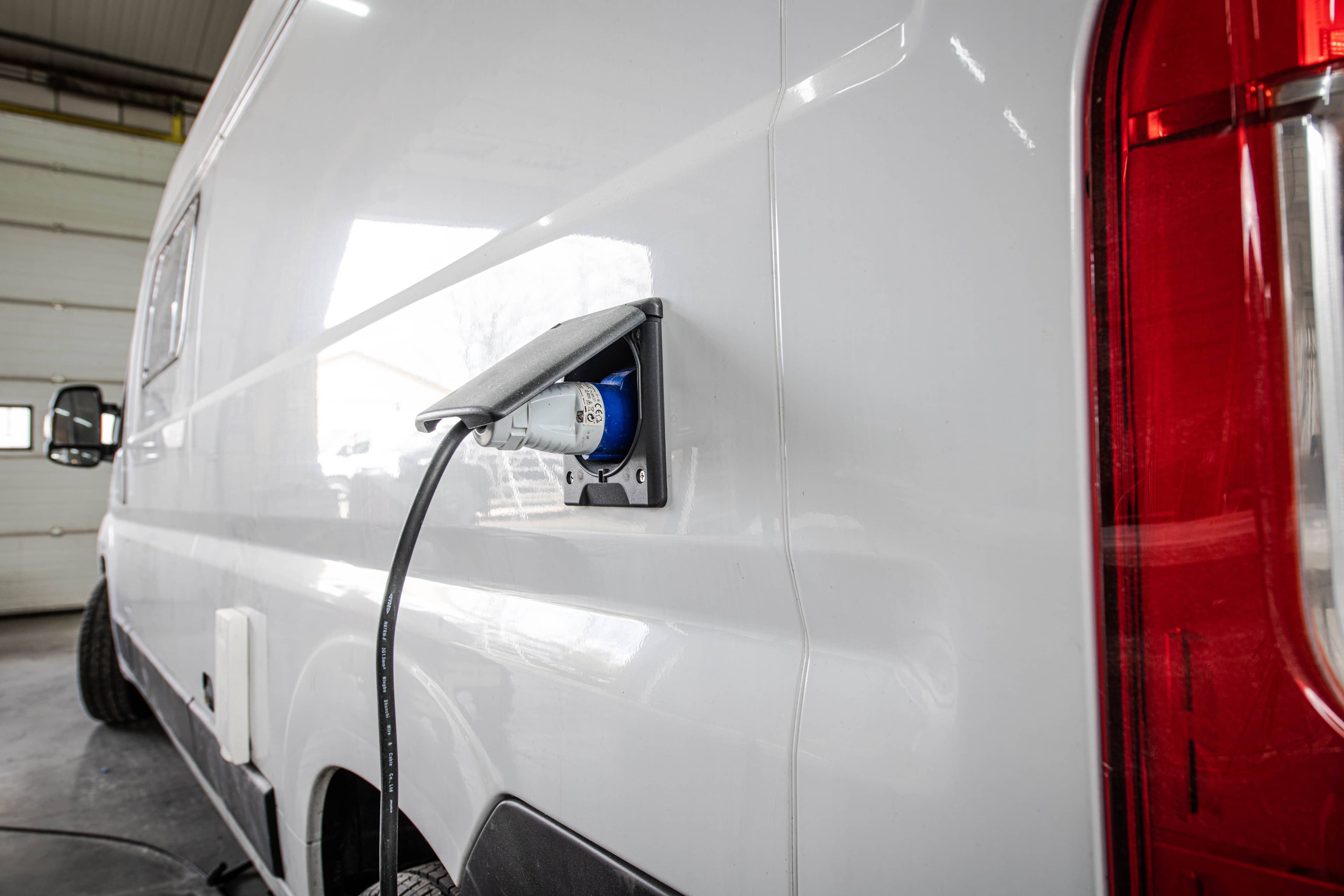
Beril Berkem • 16 June 2026
RV Shore Power: A beginner's guide
Understand the essence of having multiple power sources for your RV's electrical system and learn how to add shore power to yours.¿Necesita asesoramiento? Nuestros altamente capacitados distribuidores estarán encantados de ayudarle con cualquier pregunta, ya sea pequeña o grande.
Encuentre su distribuidor más cercano
Consulte nuestros recursos de soporte o contacte con su distribuidor original para obtener soporte específico, reparaciones o solicitudes de garantía.
Asistencia
Lea más sobre nuestra garantía estándar de 5 años, líder en el sector, y nuestro servicio de reparación global.
Garantía


©Victron Energy 2026