Dónde comprar
¿Necesita asesoramiento? Nuestros altamente capacitados distribuidores estarán encantados de ayudarle con cualquier pregunta, ya sea pequeña o grande.
Encuentre su distribuidor más cercano
What Type of Solar Panels are Best for an RV? A Comprehensive Guide
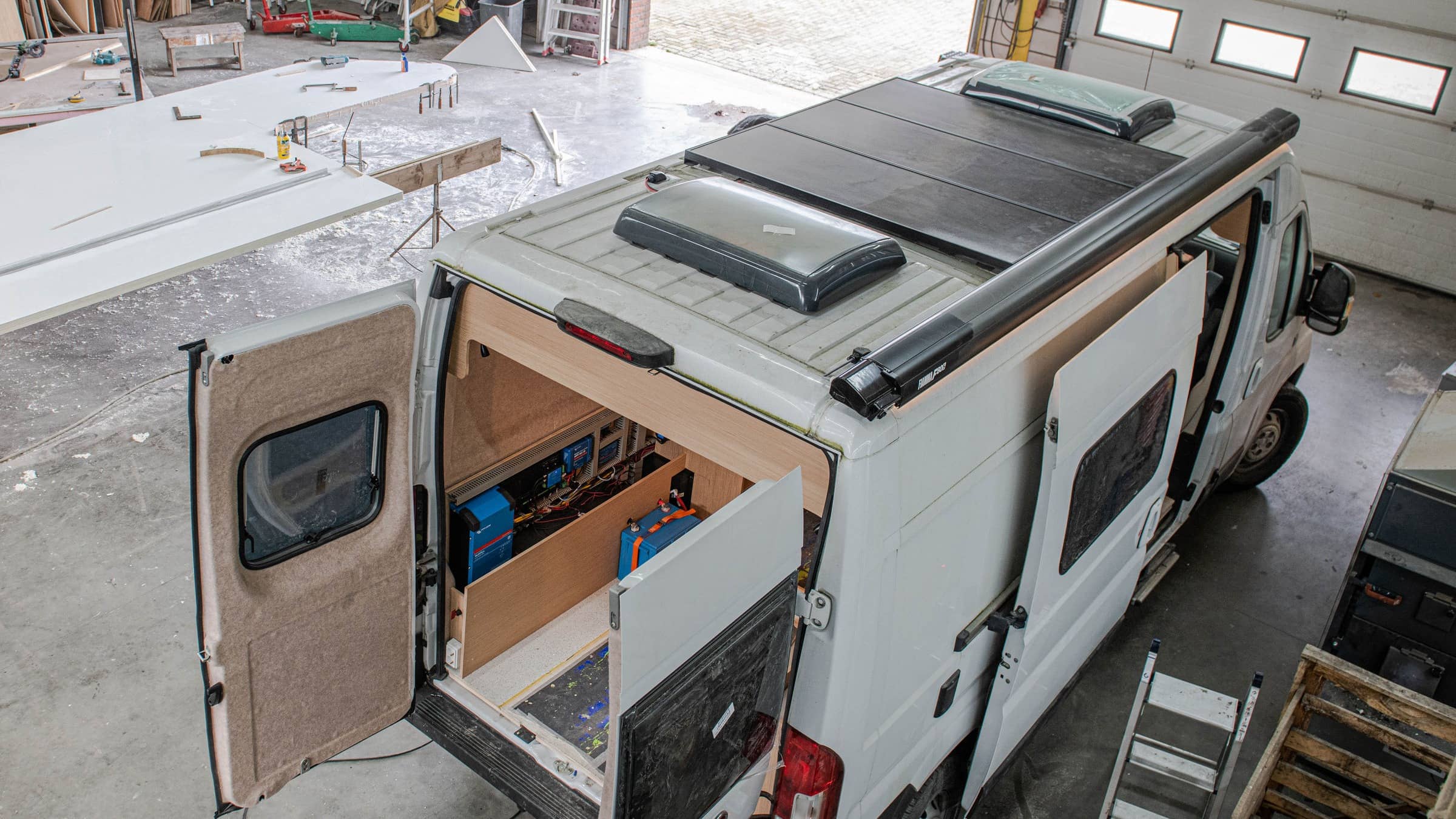
Solar panels and DC-DC chargers are what make an RV self-sufficient off-grid, but choosing what type of solar panels are best for an RV can seem daunting. The many technical terms in use by manufacturers confuse the issue and belie a decision process that’s comparatively simple. This article explains the divides within the solar panel market, going over all the terms you’re likely to see on product pages and manuals. In the end, you’ll see that choosing a solar panel doesn’t need to be a complex affair. We’ll start with a brief explanation of how solar panels work, as this will ground us with the necessary terms for diving into panel technologies and architectures.
A solar panel works by using a layer of silicon to convert light energy into electrical energy. Photons of light excite electrons in the silicon, pulling them away from the silicon atoms and towards the panel’s electrodes. This movement of electrons into the electrodes creates an electrical current, which can be used to charge and power electrical devices.
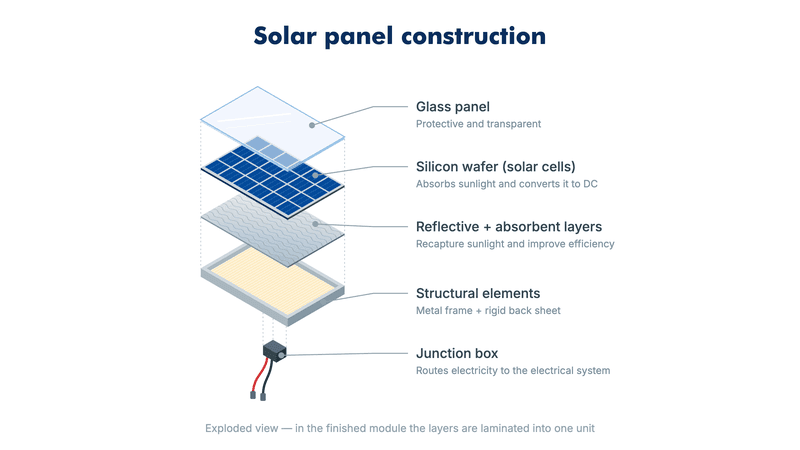
The main components of a commercial solar panel are:
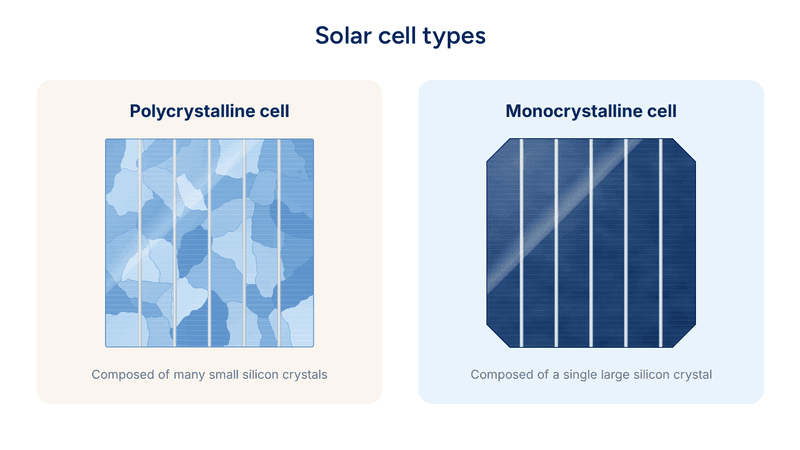
Monocrystalline and polycrystalline are two forms of silicon, and which one is used influences the efficiency and cost of the panel. As mentioned above, the silicon wafer that converts light energy to electrical energy is manufactured in its crystal form. Polycrystalline solar cells use silicon wafers that are made up of multiple small silicon crystals, whilst monocrystalline solar cells use silicon wafers made from a single large silicon crystal.
Monocrystalline solar cells are more efficient due to their uniform nature; the joints between crystals in a polycrystalline panel trap electrons before they make it to the electrodes. Claims of 20% efficiency differences between polycrystalline and monocrystalline panels are misleading; when matching for installed wattage, the power generation is almost identical. This was demonstrated in our field test of four different 2500W solar arrays; the monocrystalline array only generated 0.5% more power over three years than the polycrystalline array. The difference is in physical area: a 2500W polycrystalline array has to be physically bigger than a 2500W monocrystalline array. This area efficiency difference is important when deciding what type of solar panels are best for an RV, as roof space is often the limiting factor.
A second point is that the choice of monocrystalline vs. polycrystalline has largely been made for you. Polycrystalline panels have been squeezed out of the market due to falling costs for producing monocrystalline silicon and the fact that efficiency innovations like PERC, TOPCon, and HJT (discussed in a later section) rely on monocrystalline wafers. The wide range of sizes, formats, coatings, and cell constructions that exists today within monocrystalline panels doesn’t exist for polycrystalline panels. Therefore, by choosing polycrystalline, you’re saving a small amount of money whilst locking yourself out of a lot of choice.
Rigid and flexible solar panels differ in durability and efficiency, with rigid panels being less durable but more efficient than flexible. This is the next major decision when choosing what type of solar panels are best for an RV build, and it largely depends on how you want to install your panels. Let’s break it down.
Construction: rigid panels have a glass topsheet and aluminium frame, making them thicker (~20-40mm) and heavier (~11-12kg/m²) than flexible panels (~2-5mm and ~2-3kg/m²), which are laminated onto flexible polymers with no rigid parts.
Efficiency: rigid solar panels manage efficiency ratings of 18-23%, compared to 17-23% for flexible. Ultra-flexible CIGS/a-Si panels (discussed below) are even less efficient, at around 4-8%.
NOTE: solar panel efficiency is a measure of the percentage of the light hitting the panel that’s converted into electricity. It’s an important determiner of real-world performance in terms of electricity reaching your leisure batteries, but it’s not the only one.
Thermal behaviour: solar panel efficiency decreases as the panel heats up. Rigid panels have an air gap under the frame and mounting hardware, encouraging airflow and minimising panel heating. Flexible solar panels for RV and marine installations are installed flush to the roof, which eliminates this airflow and can cause power generation drops of 2-15% compared to rigid panels mounted with proper airflow [note 1]. A flexible panel cycling between high and low temperatures also experiences a lot more stress than a temperature-stable rigid panel, and has a consequently shorter lifespan.
Lifespan and durability: rigid solar panels are built more solidly than flexible panels. This is reflected in warranties, where 10-12 year product warranties are standard for rigid panels compared to 1-3 years for flexible panels. This is largely due to the thermal stress we mentioned in the previous bullet point. On the other hand, flexible panels are more durable in the short term in that they can more easily shrug off impacts from hail and tree branches than glass-fronted rigid panels.
CAUTION: The idea that flexible solar panels can be walked on should be treated with caution; all but the most rugged marine flexible panels are susceptible to cracking at the cell level which causes burns and loss of output. Don’t assume your flexible panels can be walked on unless this is specifically stated by the manufacturer.
Mounting: rigid panels are bolted or bracketed to the van’s roof. Drill-free brackets are a possibility, as is mounting to existing roof racks, but hardware is required in all cases. This makes installation more complex and adds 40-60mm of additional height, but it promotes airflow and is serviceable and replaceable. Flexible panels are stuck to the roof with adhesive sealant, which is a quick and easy job and results in a very low-profile installation; invisible from road level. It’s also the only viable option for mounting to fibreglass and pop-top or curved roofs. However, removing a flexible panel that has been bonded to the vehicle is much harder and invariably destroys the panel whilst damaging roof paint.
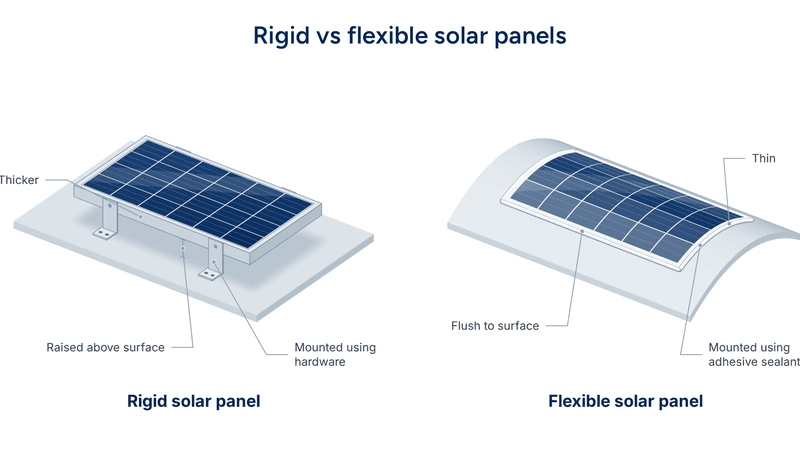
CAUTION: In practical terms, it’s strongly inadvisable to mount flexible solar panels for RV builds flush to the roof as this completely eliminates airflow. Most installers recommend using low-profile plastic battens to raise the panel and encourage airflow.
Bypass diodes and performance in shade: as discussed in our article on the shadow effect, partial shading of a solar panel significantly affects its overall efficiency. The shadow effect can be limited by the presence of bypass diodes in a panel; the more diodes, the less severe the shadow effect. Flexible panels are constructed with fewer bypass diodes than rigid panels, meaning that their performance is more heavily impacted by partial shading.
Note 1: figures derived from the Sandia National Laboratories Photovoltaic Array Performance Model.
Most flexible solar panels cannot be flexed and bent indefinitely. The bend radius is usually limited to about 30°, or as stated by the manufacturer. In addition, these panels should not be bent along multiple axes; that is, you can bend a flexible panel along its long side, or along its short side, but not both.
Thin-film solar panels (which encompass CIGS and a-Si or amorphous silicon panels) can be rolled up like a sheet of paper. The trade-off is that they’re only about 4-8% efficient.
The outer coating or topsheet of a flexible solar panel is a major factor in the panel’s durability. Ethylene tetrafluoroethylene (ETFE) coatings are UV-stable, reducing yellowing and peeling from sunlight exposure. They’re also ‘self-cleaning’ meaning they shed water and dirt well. A textured ETFE coating captures angled sunlight better than smooth, but doesn’t shed dirt as well and might need more frequent cleaning.
Polyethylene terephthalate (PET) coatings are cheaper but quickly damaged by UV. This discolours the panel, reducing performance, and causes peeling, allowing water penetration and eventual loss of function.
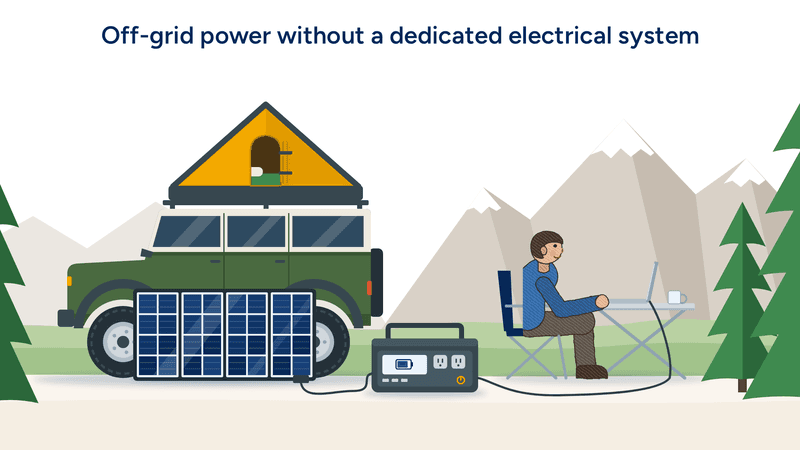
Portable solar panels are a separate class which are not permanently mounted on your RV’s roof. These panels are foldable, designed to be packed up and stowed away when not in use. Rigid portable solar panels that fold up like a briefcase used to be widely available, but the market has shifted and is now dominated by flexible portable solar panels. These panels therefore possess all the properties, good and bad, of flexible solar panels discussed above.
The main benefit of portable solar panels to RV users is that they require no permanent installation. If installation worries you, or if you’re looking at getting started with RV solar systems but not ready to take the plunge, portable panels are a good way to experiment before committing. Portable panels are also easy to tilt and move around as the sun moves, meaning you might get better power generation than with fixed flexible panels.
It’s worth noting that portable solar panels must still be paired with a solar charge controller in order to charge your leisure batteries. To some, this might defeat the point of a low-commitment installation. Instead, you might prefer to pair your portable solar panels with a portable power station. This is essentially a miniaturised off-grid electrical system, incorporating a leisure battery, a solar charge controller, and sometimes an inverter. Manufacturers of portable solar panels usually also make portable power stations, allowing both devices to work together.
Within the world of monocrystalline solar panels, efficiency advancements have been made through developments in how the panels are constructed.
When a silicon wafer is produced for a solar panel, it’s ‘doped’ with either boron, gallium, or phosphorus to aid electron movement. P-type panels are doped with boron or gallium, which is cheaper but carries an inherent performance loss due to chemical degradation in sunlight. N-type panels are doped with phosphorus, which doesn’t degrade in the same way, meaning they perform better and degrade more slowly.
Cell architecture is the way the silicon wafer is arranged with the layers of other material that make up a solar cell.
Al-BSF (aluminium back surface field): a simple aluminium backing sheet to the silicon wafer. Cheap, but offering unremarkable performance.
PERC (passivated emitter and rear cell): produces re-absorption of unused light and increases efficiency. These panels are of the p-type, with the drawbacks discussed above. P-type was the industry norm for domestic panels until about 2023, but is now being superseded by TOPCon.
TOPCon (tunnel oxide passivated contact): similar to PERC but further increasing efficiency of electron capture whilst using superior r-type wafers. This is now the mainstream architecture in large-scale industrial production.
HJT (heterojunction): sandwiches an r-type silicon wafer between thin amorphous silicon (as used in ultra-flexible panels) layers. This architecture has the best temperature performance and low or diffuse light performance (important on cloudy days) of all architectures, but is more expensive than PERC and TOPCon. For now, there aren’t many 12/24V solar panels using this architecture.
IBC (interdigitated back contact): a variation in the arrangement of the electrical contacts in the cell, where all electrical contacts are in the rear, meaning they don’t produce shade and allow for tighter packing of cells. This contact architecture can be combined with the cell architectures described above. It’s much more expensive than the standard contact arrangement, and usually only found in premium marine panels.
Half-cut and split cell are interchangeable terms used for the same thing; a panel composed of cells where each cell is split in two. This halves the current per cell, reducing electrical resistance and increasing performance. Splitting cells also doubles the number of bypass diodes in the panel and significantly reduces the effect of partial shading on electricity production.
Shingled cells are a new construction method where the cells are half-cut and then overlapped like roof tiles rather than lying flat. This increases surface area and reduces the area taken up by electrical contacts, increasing electrical production for a given area of solar panel. This construction is rare in the 12V market for now.
Rigid solar panels always perform better than flexible ones, so flexible panels are only preferable for a specific requirement such as ruggedness or a curved roof. Even if you have a plastic or fibreglass roof, adhesive mounting brackets can allow a drill-free installation, so don't choose flexible for this reason alone.
Whether you choose rigid or flexible, monocrystalline gives you the best base efficiency and the most options. Beyond this, simply choose a panel from a reputable manufacturer that fits your roof. PERC is a good choice, but may add significant expense without necessarily boosting performance. There's no need to agonise over specific technologies and architectures, as these will only provide marginal gains. For domestic and industrial systems where the installation is optimised and fixed, the small gains from high-tech solar panels build up noticeably over time. In an RV application, where orientation, shading, and temperature patterns are constantly in flux as you travel, you're unlikely to notice these gains. Other elements of the installation matter more:
Shading affects solar panel performance more than anything else. Make sure that nothing structural could throw shadows over your solar panels; pay attention to roof racks, antennae, and fans; mount solar panels either higher or out of the way. Half-cut panels or panels with good shaded performance - using bypass diodes - will help manage the effect of partial shading from trees.
Temperature is the next most important thing to consider. Flexible solar panels should never be stuck flush to the roof; raise them up on spacers that allow air to flow under the panel. If you’re using low-profile mounting hardware for rigid panels, make sure air can still flow freely underneath. Hot panels aren’t as efficient and degrade more quickly.
Finally, a good solar charge controller is essential for squeezing the most performance out of your RV solar panels. As we discuss in our explainer on PWM and MPPT charge controllers, MPPTs are more efficient for all but the smallest solar systems. These more advanced devices ensure that your solar panels are being used to their fullest capacity to charge your leisure batteries, even at very high temperatures and when sunlight is weak.
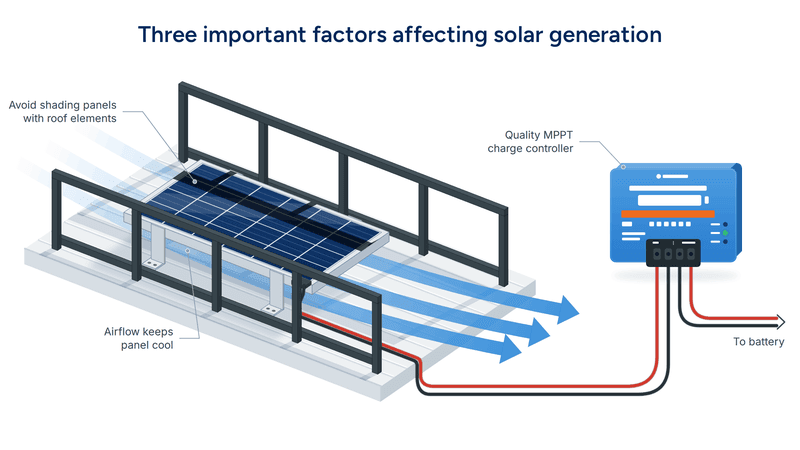
Solar panel technology is only one part of an efficient solar system. Once you’ve chosen a rigid, monocrystalline panel that fits your roof - choosing PERC cells if available and within budget - shading, temperature, and the efficiency of your solar charge controller have a greater effect than specific panel architectures. Quality cables, fuses, and connections minimize the loss of power from your panels to your batteries, so don’t skimp here.
For advice on sizing a solar array to suit your needs, take a look at our comprehensive guide, and see our overview of the components of an RV electrical system to see how solar panels fit into this wider context.
Beril Berkem • 16 June 2026
How much does an RV solar system cost?
Get a feeling for the cost of an RV solar system and its components through some helpful examples and tips.
Beril Berkem • 04 May 2026
How to size a solar system for your RV
Learn how to size a solar system for your RV. Estimate your energy needs and choose the right components to power your adventures.¿Necesita asesoramiento? Nuestros altamente capacitados distribuidores estarán encantados de ayudarle con cualquier pregunta, ya sea pequeña o grande.
Encuentre su distribuidor más cercano
Consulte nuestros recursos de soporte o contacte con su distribuidor original para obtener soporte específico, reparaciones o solicitudes de garantía.
Asistencia
Lea más sobre nuestra garantía estándar de 5 años, líder en el sector, y nuestro servicio de reparación global.
Garantía


©Victron Energy 2026